OUR
OPERATIONS

Bapco is dedicated to providing high-quality customer service through flexibility in cargo lifting schedules, cargo size, and product quality. The Company is constantly monitoring the oil market, seeking opportunities to maximise revenue from the sale of refined products and capitalise on niche markets as appropriate.
The pandemic caused a significant loss in global oil demand as many restrictions, including lockdowns, travel bans, border closures, and work-from-home measures, were put in place to mitigate the spread of Covid-19. Global crude oil prices collapsed throughout 2020 and 2021 to their lowest levels, as concerns over a virus-driven fall in demand overshadowed a historic OPEC+ agreement by the world’s biggest producers to cut production. Nevertheless, in 2022, the Russia-Ukraine war caused supply availability concerns within the market, which led to a significant increase in crude oil prices. Furthermore, a global economic recovery, coupled with China’s reopening via the removal of lockdown restrictions, led to an increase in crude oil demand. As a result, the markets witnessed global demand growth optimism towards Q4 2022.
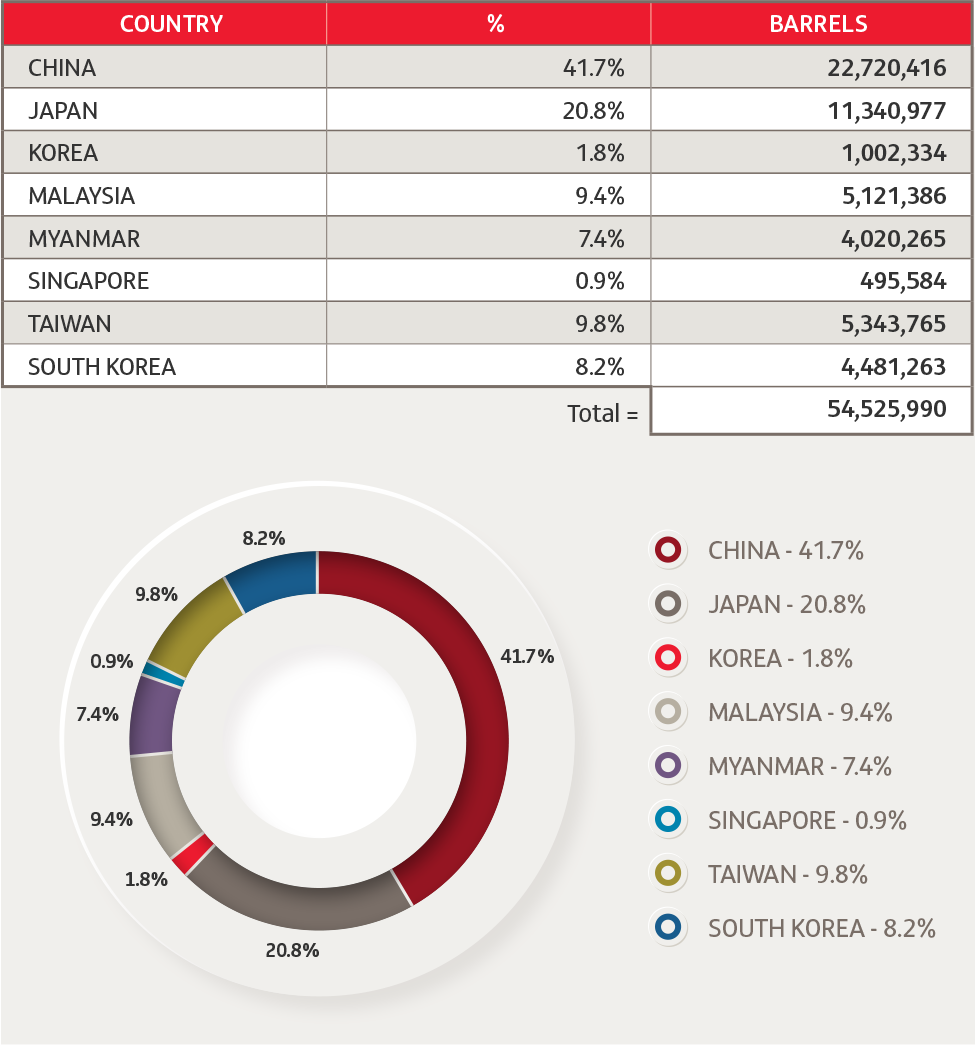
Bapco markets the Government of Bahrain’s equity share of about 150,000 barrels per day (bpd) from the Abu Safah offshore oilfield, which is jointly owned by Bahrain and Saudi Arabia. The year’s sales of Abu Safah crude oil totalled 54.5 million barrels, all exported to markets east of the Suez, notably the Far East (with China having a 41.7% share of exports to this region) and Southeast Asia. The quantity of barrels exported in 2022 was nearly equivalent to that of 2021.

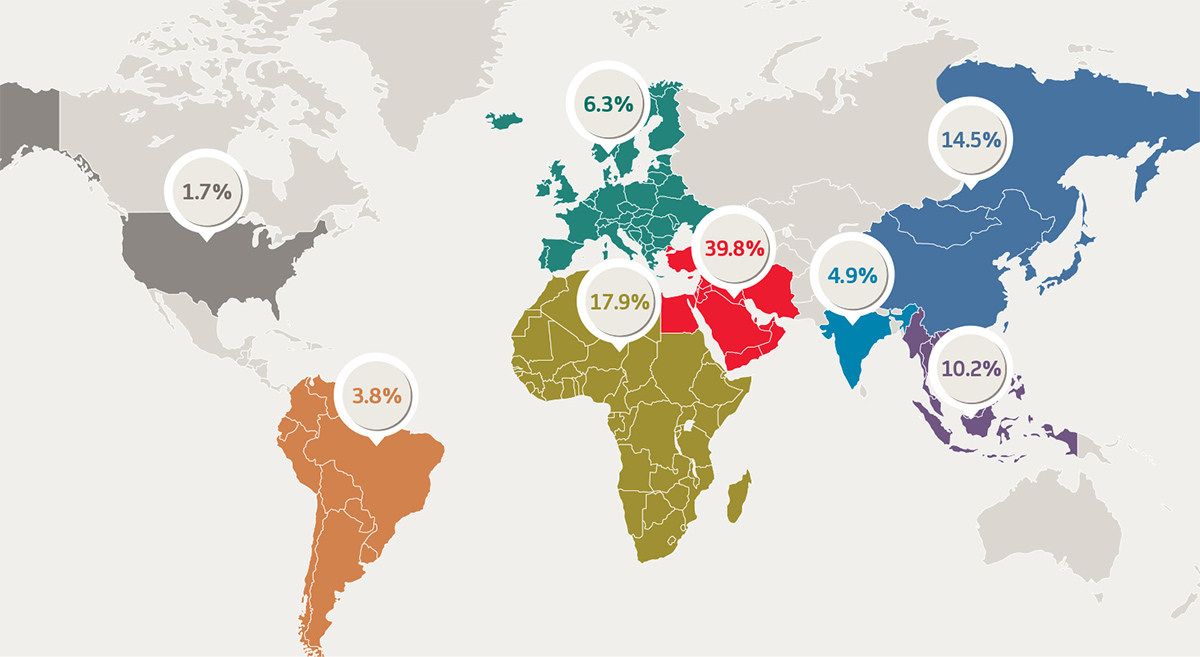
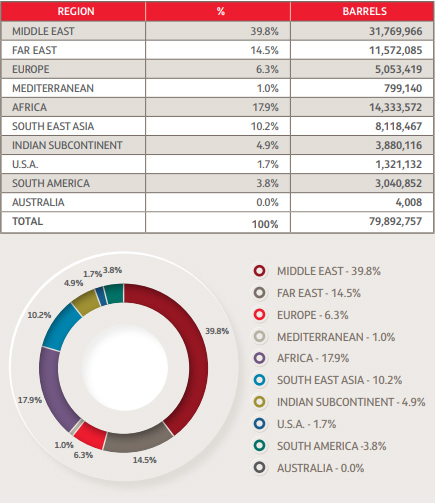
Middle Eastern countries were the biggest export destinations and accounted for 39.8% of export destinations, followed by Africa 17.9%, the Far East 14.5%, Southeast Asia 10.2%, Europe 6.3%, India 4.9%, South America 3.8%, and the USA 1.7%.
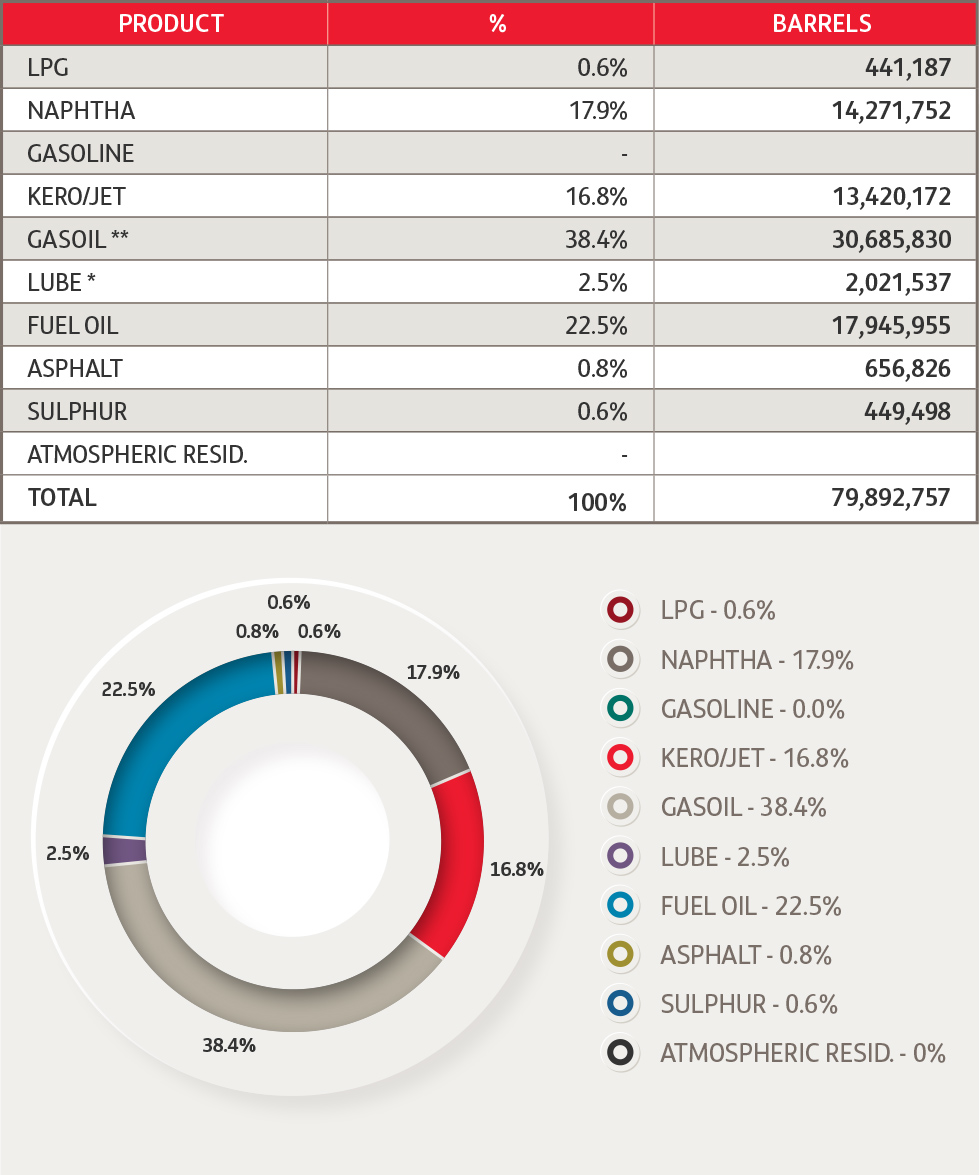
The refining industry continued its recovery in 2022 in comparison to the pre-pandemic years as demand continued to increase. The demand for middle distillates increased significantly, and as a result, refining margins increased to unprecedented levels, incentivising many refineries around the world, including Bapco, to maximise their crude runs. In 2022, Bapco managed to achieve a higher product sales premium in the spot market in comparison to 2021, 2020, and 2019, and generate value from this. Additionally, Bapco maintained its market share in terms of volume supply and secured stable outlets for its almost 79.89 million barrels of refined products during 2022.
The Kerosene/Jet Fuel markets continued to recover from the pandemic, with sales increasing as travel restrictions were eased and borders opened. Moreover, an increase in sales of Gasoil was also observed as easing pandemic restrictions allowed for an upturn in economic activity. With the economics being in favour of Gasoil for most of the year, Bapco successfully optimised its operations and maximised routing kerosene to the diesel pool. The Fuel Oil market also witnessed an increase in sales as trade increased with the economic recovery in 2022, despite an increase in inventories due to higher refinery throughputs. Bapco managed to secure an outlet for the whole volume of the Fuel Oil at a very attractive price.
Following the exit of Neste from the Bahrain Lube Base Oil Company joint venture (BLBOC), Bapco was able to successfully conclude a deal that resulted in the transfer of the asset to the Government of Bahrain (nogaholding), while selling the 45% share of total production to Chevron.
Additionally, Bapco was able to successfully renegotiate its base oil offtake agreement with Shell International Trading Middle East Limited FZE, delivering an additional net margin of around US$102/MT.
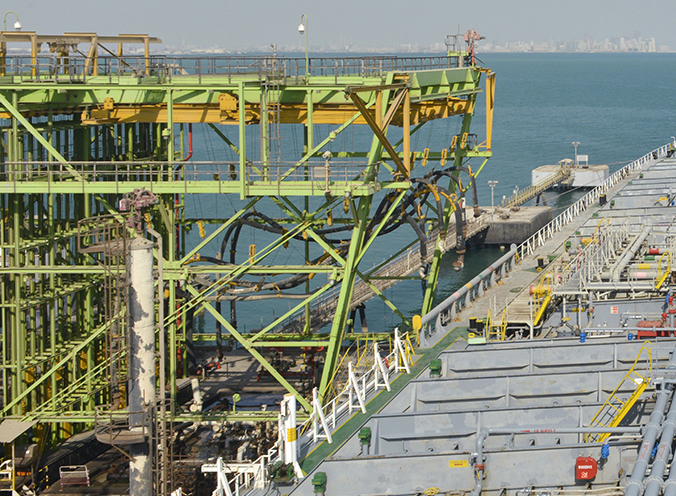

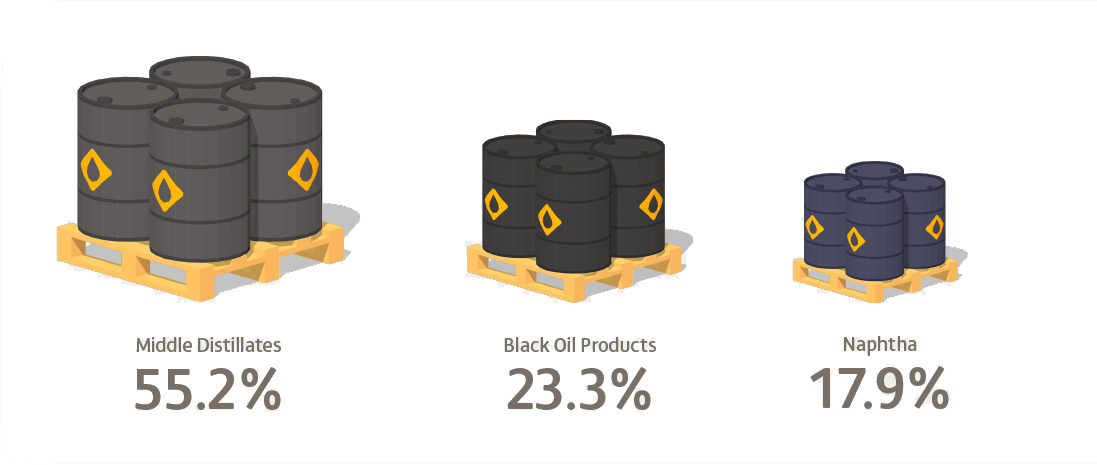
In 2022, a total of 79.89 million barrels of products were exported, with middle distillates accounting for 55.2% of sales. Black oil products (Fuel Oil and asphalt) followed at 23.3% and Naphtha at 17.9%.
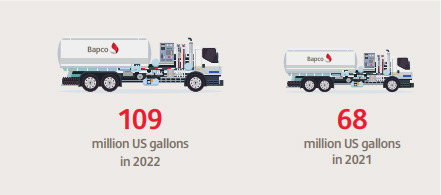
Accordingly, Bapco’s Aviation Jet A1 fuel sales in 2022 were up 62%, reporting total sales of around 109 million US gallons in comparison to 2021, with total sales of around 68 million US gallons.
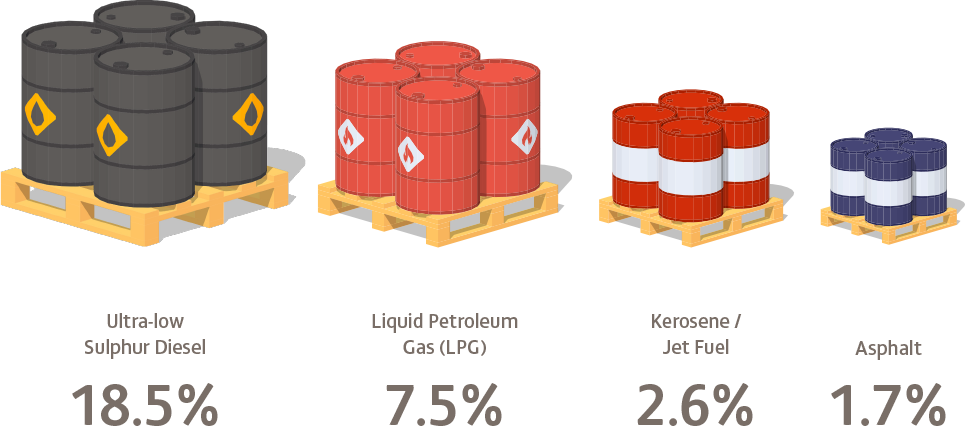
Sales of ultra-low sulphur diesel accounted for 18.5% of the domestic sales (down from 20.5% in 2021), followed by Liquid Petroleum Gas (LPG) at 7.5% (down from 7.6% in 2021), and Kerosene and Jet Fuel at 2.6% (down by 0.2% from 2021). Asphalt accounted for the remaining 1.7% of local market sales.
The end of the lockdown, along with effective health measures, led to substantial economic growth in the local market, which has been reflected positively by an increase in domestic sales of refined products since 2021. The total volume of refined product sales amounted to 11.3 million barrels, an increase of 9.0% year-on-year compared with 2021, thus maintaining the sales growth trend.
The dominance of more affordable Jayyid gasoline (91 RON) continued over the more expensive, higher-octane Mumtaz (95 RON) gasoline in the local market. As a result, Jayyid gasoline continued to account for almost half of the refined products sold domestically at 53%, compared to 51% in 2021. Mumtaz gasoline’s domestic market share increased moderately to 15.7% compared with 15% in 2021, while Super Gasoline (98 RON), the premium gasoline grade, accounted for less than 1%.
The import operation of RON 98 (“Super 98”) gasoline saw a crucial change in 2021, moving away from the use of ISO containers to direct transfer between Sitra Wharf and Sitra Marketing Terminal. As this change was implemented to provide a time and cost-saving benefit (reduction of lead times from 37 days to 7 days while reducing costs by 18.7%), the direct import process has continued into 2022 to further capitalise on these benefits
A total of approximately 79,500 bbl of 98 RON was imported via seven cargo shipments throughout 2022, averaging one import every 52 days.

Accepted at all 60+ service stations in the Kingdom of Bahrain, the Sadeem card maintains its dominance in fuel transactions at a corporate level in addition to providing customers with an industry-leading cashless payment experience. The launch of the Sadeem virtual card on the “Benefit Pay” mobile application empowered retail consumers to take advantage of contactless payment at all service stations. This led to a significant growth in the Sadeem card customer base and, subsequently, an upsurge in card transactions from 10% to 35%.