Bapco is committed to the protection of health, safety, environment and welfare of its employees, contractors, and its neighbouring communities. This commitment is evident in its operating policy and business philosophy which provides special emphasis to achieving sustainable development across the three pillars of sustainability: social, economic, and environmental.
Bapco is one of the largest employers in the Kingdom of Bahrain, and is considered an employer of choice, which not only makes a significant economic contribution to our beloved Kingdom, but has been taking a lead in the advancement of the environmental and social fabric of our great nation since the Company’s inception in 1929.
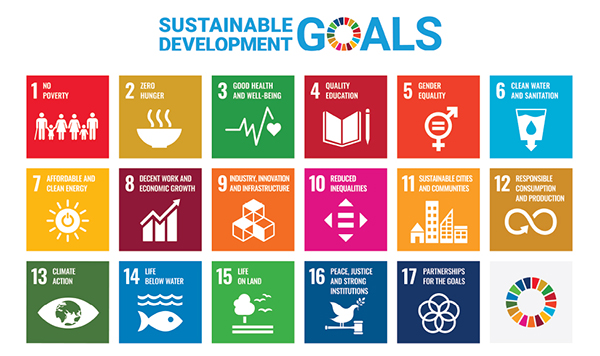
Bapco’s strategies are aligned to achieve the Kingdom of Bahrain’s Economic Vision 2030 which is designed to balance the many conflicting needs of sustainability, fairness and competitiveness. At its heart is a shared goal of building a better life for every Bahraini. By achieving this vision, we have aligned the aspirations of our future generations with sustainable development. Bapco’s contribution to the Economic Vision is measured by alignment with the 17 Sustainable Development Goals (SDG’S) issued by the United Nations in 2017, which encompass technological advancement, environmental stewardship, economic progress and societal welfare.
Bapco has also adopted the Ten Principles of the United Nations Global Compact (UNGC) on human rights, labour, environment and anti-corruption. These Principles are intrinsic to Bapco, and our strategies and operations are aligned with these principles, so that they are part and parcel of our culture and day-to-day license to operate.
Collectively, Bapco’s contribution to sustainable development, UN 17 SDG’s and UNGC 10 Principles is highlighted in detail in our latest Sustainability Report for 2020/2021 which can be accessed via https://www.bapco.net/en/page/we-care/#we-care
Bapco’s Environment, Social and Governance (ESG) Initiatives
In Bapco, sustainability is a journey which is reflected in its ESG initiatives as highlighted i the following text. All of Bapco’s sustainable development initiatives can be linked to the 17 SDGs and the Ten Principles of the United National Global Compact (UNGC)
The significant size of the Bapco Modernization Programme (BMP) project provides both short and long term opportunities for the local labour market and local supply chain. The BMP has created new skilled positions filled from positions advertised locally within the Kingdom. In addition to this very significant contribution to the local economy, Bapco makes special provision for providing to the community during particular times of the year. For example, during the holy month of Ramadan, Bapco provides all operators with meals during Iftar and arranges food distribution campaigns to the community, thereby supporting the SDG goals of no poverty and zero hunger and the UNGC principles of labour, human rights and the environment.
Under good health and wellbeing, all Bapco employees have access to the Refinery clinic and free treatment at Awali hospital. Bapco supports community wellbeing awareness via campaigns and events, for example the Family Day which was held in January 2020 at the Bahrain International Circuit and attended by more than 37,000 people. Each month specific health campaigns have been run during 2022 on various topics such as breast and prostate cancer, diabetes and hypertension awareness.
Bapco plays a significant role in providing quality education in the Kingdom of Bahrain. Bapco provides the company with the best skilled workforce necessary for the future through its Training and Development Department. Along with the support provided to the employees and students, Bapco employees participate in the INJAZ programme, lecturing to students on science and engineering. Bapco also believes in equal opportunities irrespective of gender and has many women holding senior appointments across Bapco, supporting the SDGs on gender equality and the UNGC human rights and labour principles. Bapco has specific policies designed to tackle inequality, implemented by a dedicated team who work with contractors to monitor any potential breaches in Bapco policy. Bapco has for several years inducted both men and women trainees into engineering disciplines. Bapco’s meritbased International Scholarship Programme provides financial support for students of all backgrounds to study at some of the best institutions worldwide.
Bapco continues to provide new opportunities through the BMP expansion, creating one of the most technologically advanced Refineries in the world. CLG, NAPCON, and Bapco have opened the LC-FINING Center of Excellence in Bapco Training and Development Department. The Department also plays a leading role in training for existing employees throughout their career at Bapco. In addition, Bapco has a strong track record for technological innovation. Bapco has an Innovation Centre to nurture new ideas suggested by employees, using initiatives such as the ‘Seed’ programme to recognise employees for their innovative ideas. Bapco additionally participates in community initiatives designed to encourage innovation, such as the Green School Award Scheme launched in 2005, aimed at the government secondary schools to identify and pilot sustainability-related ideas. This supports the SDG’s decent work and economic growth goal and also industry and innovation, as well as UNGC principles.
Bapco has undertaken many recent initiatives to improve social and environmental capital within the Kingdom of Bahrain, such rehabilitating community gardens for the public benefit and use.
Under the SDG’s relating to climate change, clean water and sanitation, and clean and affordable energy, Bapco is committed to support the Bahrain National Target to combat Climate Change announced at COP26 held in Glasgow, UK in 2021. Bapco has also established an Energy Group and an Energy Committee that focus on energy conservation throughout the Refinery, leading to projects and initiatives focusing on energy reduction and efficiency improvement using the latest technologies and means of monitoring. Bapco has been reporting its Greenhouse Gas (GHG) emissions since 2014 and has implemented several initiatives to reduce those emissions, such as the hydrogen plant CO2 recovery project that saves 40,000 tonnes of CO2 emitted per year, the solar benches installed across Bahrain, our 5 MWp Distributed Solar Energy Pilot Project (BDSEPP) and the maintenance of green spaces such as Princess Sabeeka Park in Awali Township. BMP will also contribute to an important reduction of energy using latest technologies. Additional initiatives are being taken by Bapco, such as the use of innovative software to optimise steam and power generation and the replacement of heaters with the latest energy efficient technologies. Bapco has also invested in the latest technologies to minimise water abstraction required for refining. Bapco’s Waste Water Treatment Plant and Sewage Treatment Plant (STP) uses state-ofthe art advanced Membrane Bioreactor Technology for water and effluent treatment. To support SDGs relating to life on land and life below water, Bapco has been conducting regular marine assessments since 1981 around the Bapco Refinery and Sitra operating facilities to monitor marine ecosystems. Results have shown a significant improvement due to Bapco initiatives such as biological effluent treatment plant. Bapco’s efforts to plant mangroves will stabilise near-shore sediments, enhance blue carbon and encourage ecosystem diversity. Bapco closely follows the guidance provided by the Supreme Council for Environment (SCE) on enhancements to the natural and built environments.
Bapco is proud to follow all applicable national and international regulations for fair process. Bapco has an established code of ethics that describes the behaviours expected from all employees, contractors and other third parties who work for Bapco. Bapco also conducts comprehensive social impact assessments for its major projects in accordance with applicable laws and regulations, with stakeholder engagement to facilitate community consultation. Bapco has long-standing partnerships with programmes such as INJAZ for the benefit of the community, supporting the SDG relating to peace, justice and institutions and partnerships for the goals in addition to the ten UNGC principles.